AI-native engineering
Ship faster with AI, and catch mistakes before customers do.
Your engineers already use coding agents. The time they save comes back as changes to redo, pull requests waiting for review, and incidents. Senior engineers from our team work in your repository and CI to fix the causes, and we track defects and review time next to delivery pace, so you can show the gain is real.
AI-native engineering is getting a codebase ready for coding agents: tests, module boundaries, and review rules that let agents change code safely, and measures that show whether quality holds as speed goes up.
The problem
What blocks agents is usually the codebase, not the model.
Agents copy the patterns they find and trust the checks you give them. When those are weak, the time they save comes back as work for your team.
Changes get redone.
Tests are slow, flaky, or missing, so an agent cannot tell whether its change works, and the mistakes reach review.
What it costs
Your engineers spend the time agents saved fixing and redoing changes.
Pull requests wait for review.
Module boundaries are unclear and conventions live in people's heads, so agent changes spill across concerns and each one needs a careful read.
What it costs
Senior engineers read pull requests instead of building.
Defects reach customers.
Weak types, thin linting, and little CI feedback let changes compile and then fail at runtime.
What it costs
Customers find the problems, and your team stops trusting agent output.
Engagement
The first fix ships early.
You see changes in your repository, not just a report. You keep the diagnosis and the fix either way.
Start: find what costs your team the most, and fix it
We read your code and CI history, talk with the engineers who maintain it, and run agents against real tasks from your backlog to see where they fail. Then we fix the gap that costs your team the most, such as a slow or flaky test suite or a tangled module boundary, and run the agents again to check the fix holds. At a checkpoint, we recommend whether to continue, change course, or stop. "Not yet" is a valid answer.
You keep
A baseline of how agents do on your real work, what we learned from your engineers and CI history, the shipped fix, and our recommendation.
Continue: senior engineers inside your team
If you continue, senior-led, forward-deployed engineers work in your repository and CI next to your engineers, against a roadmap you set with us. The people who advise you are the people who do the work. A named accountable lead from our team owns the outcome and raises risks early.
You keep
Tests, checks, review rules, and the decisions behind them, owned by your team.
If the better answer is process or ownership rather than agents, we will say so. If what you want is ticket throughput without engineering judgment, we are not the right team.
Review
Agents write more code than people can read line by line.
Review is where the gains get lost. We agree a written rule with your team for which agent changes get a quick approval and which get a full review, and we make that rule checkable.
| The change | How it is checked |
|---|---|
| Low-risk changes in well-tested areas, such as small refactors and internal tooling. | Passing tests, type checks, and lint, a first-pass review, then an engineer spot-checks and approves. |
| Changes to shared modules and business logic. | The same checks and first-pass review, then an engineer reads the change before approving. |
| Changes that touch auth, payments, data migrations, or public APIs. | A person reviews the full change. Agents help prepare it and do not decide it. |
How we do first-pass review
Praxis Factory
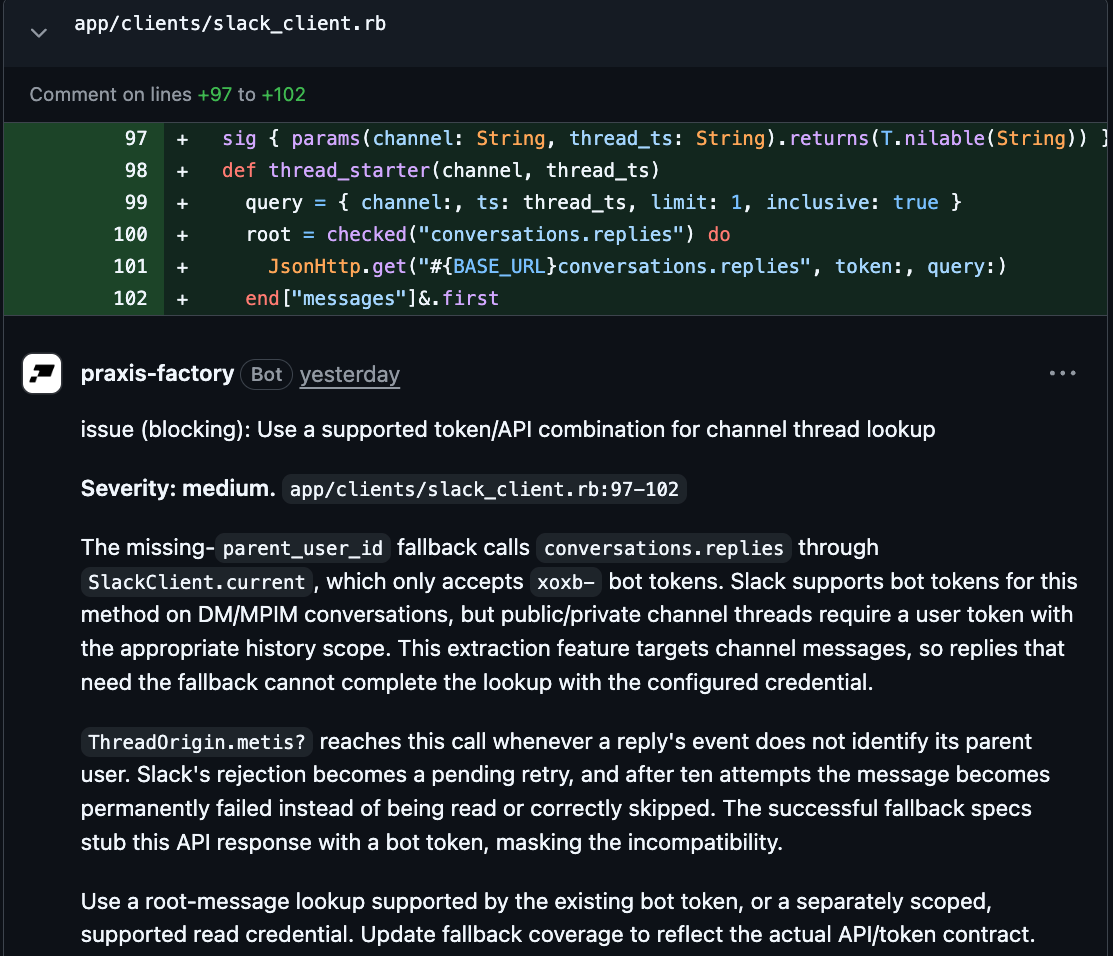
Praxis Factory is our code review system. It reads each pull request through six lenses, starts every review with a clean context, and reports only findings it has checked against the code. By default, a person approves the merge.
Six lenses: architecture, readability, testing, maintainability, security, and documentation.
Whether Factory may approve changes on its own is something we agree with you. It depends on your security and data constraints, how much review capacity your team has, and how risky the area is.
Measurement
We track quality next to speed.
Delivery pace alone can look good while quality slips. We report these three measures next to it, so you can see whether the gain holds.
- Escaped defects
- Defects in agent-written changes that reach customers.
- Rework
- Agent-written changes that have to be redone or reverted after they merge.
- Time in review
- How long agent-written pull requests wait for a person, and how much they need changing first.
Free skills
Not ready for a call? Run two free skills on your own repo.
Assess the repository first, then scaffold the context agents need. Both skills are free and run locally against your repo. The install instructions arrive by email.
Step 1. Assess
codebase-readiness
Find out how ready your repo is for AI agents.
codebase-readiness scores your repository across eight dimensions, including test foundation, architecture clarity, type safety, feedback loops, and documentation. It returns a roadmap of what to fix first.
What it measures
What you get
- A score from 0 to 100 with a band rating
- A breakdown of strengths and gaps for each dimension
- A roadmap ordered by impact, not effort
- Recommendations tied to your actual codebase
- Test Foundation
- Tests are how an agent checks that its change works, so their coverage and reliability limit what it can safely change.
- Feedback Loops
- Fast CI and local checks set how many times an agent can try, verify, and correct its work in a day.
- Documentation & Context
- Clear, consistent docs tell an agent your conventions and past decisions, so it does not have to guess them from code.
- Code Clarity
- Small, well-named files let an agent hold a whole unit of logic in context and change it with confidence.
- Consistency & Conventions
- Enforced linting and formatting let an agent copy patterns reliably and catch its own style mistakes.
- Type Safety
- Types, or contracts and validation in dynamic languages, catch an agent's mistakes before they reach runtime.
- Architecture Clarity
- Visible domain boundaries let an agent find where a change belongs without reading the whole codebase.
- Change Safety
- Low coupling, safe migrations, and quick rollback keep the reach of an agent's change small.
Step 2. Scaffold
agent-ready
Give agents the context a new engineer would need.
agent-ready reads your repository and scaffolds the docs agents read before they code, plus a quality gate that checks what they change. It builds from your actual structure, not a template, and adds docs, scripts, and CI config next to your code. Treat the output as a first draft for someone close to the product to review.
What it creates and its modes
What you get
- AGENTS.md as the agent entry point
- ARCHITECTURE.md naming modules, boundaries, and invariants
- docs/DOMAIN.md seeded with your business terms and workflows
- docs/README.md as an index of your documentation
- A CI quality gate that fails on new complexity, duplication, and dead code, with a baseline your team reviews for existing debt
- scaffold
- Runs the full setup: the docs structure, ARCHITECTURE.md, docs/DOMAIN.md, AGENTS.md, a documentation check, and a quality gate.
- architecture
- Writes ARCHITECTURE.md from your actual code, with a codemap, invariants, and boundaries.
- agents-md
- Creates AGENTS.md, or trims an existing one, into a short entry point that links to deeper docs.
- quality-gates
- Installs complexity, duplication, and dead-code checks that fail CI on new debt, with a reviewed baseline for the debt you already have.
- migrate
- Upgrades a repository set up by an earlier version of agent-ready to the current documentation layout, after you confirm the plan.
- audit
- Checks existing agent docs for stale content, broken links, and conflicting instructions.
Questions
Questions about AI-native engineering.
What does it mean for a codebase to be ready for AI agents?
Agents copy the patterns they find and trust the checks you give them. A codebase is ready when its tests tell an agent whether a change works, its module boundaries show where a change belongs, its types and linting catch mistakes early, and its conventions and past decisions are written down. When those are weak, the time agents save comes back as rework.
Which agent-written changes need a full human review?
We agree a written rule with your team. Low-risk changes in well-tested areas get a first-pass review and a quick approval. Changes to shared modules and business logic get an engineer's read before approval. Changes that touch auth, payments, data migrations, or public APIs get a full review by a person.
What is Praxis Factory?
Praxis Factory is our code review system. It reads each pull request through six lenses: architecture, readability, testing, maintainability, security, and documentation. Each review starts in a clean context, and it reports only findings it has checked against the code. By default, a person approves the merge. Whether it may approve changes on its own is something we agree with you.
What happens first when we work with you?
We read your code and CI history, talk with the engineers who maintain it, and run agents against real tasks from your backlog to see where they fail. Then we fix the gap that costs your team the most and run the agents again to check the fix holds. At a checkpoint after that, we recommend whether to continue, change course, or stop. "Not yet" is a valid answer.
How do you know the speedup is real?
We track escaped defects, rework, and time in review next to delivery pace, and report them to you. Delivery pace alone can look good while quality slips.
What do the free skills do?
codebase-readiness scores your repository across eight dimensions and returns a roadmap of what to fix first. agent-ready scaffolds the docs agents read before they code, plus a CI quality gate. Both are free and run locally against your repo.
Related work
Work on more than the codebase.
AI transformation
Change how your company works with AI.
See AI transformationAI executive coaching
Lead on AI from your own experience.
See AI executive coaching
Tell us where agents slow your team.

On a short call, tell us how your team uses agents and where the time goes. We'll say whether we can help and what we would fix first.